
How to play rock paper scissors in one line: two sides show a hand at the same moment, a fist for rock, a flat palm for paper, two fingers for scissors. Rock beats scissors, scissors beat paper, paper beats rock, and matching hands tie. InOut’s casino version keeps those rules and puts a stake on them. You bet, throw against a random hand, and climb a multiplier ladder with every win until you cash out, lose, or reach 20 wins.
Rock paper scissors rules in one cycle
The rules form a loop with no top hand. Rock blunts scissors. Scissors cut paper. Paper covers rock. Because each hand beats exactly one other and loses to exactly one other, no throw is better on its own; what matters is what the other side throws.
When both hands match, nobody wins. Playground games just go again, and so does the casino version, which keeps your multiplier where it was.
Rock, paper, scissors, shoot
Between two people the usual count is three pumps of a closed fist while saying “rock, paper, scissors”, then the hand comes out on “shoot”. Some groups throw on the third word instead. Agree on it first; a lot of playground arguments start with one player throwing a beat early.
How do you play rock paper scissors at a casino?
Here is a round of InOut’s Rock Paper Scissors as it ran in the studio’s demo on 11 November 2026.
- Set the stake with the up and down arrows next to the bet box.
- Press Play. The bet is taken and the ladder starts at x1.00.
- Tap rock, paper or scissors, or press Random and let the game pick for you.
- The opponent’s card flips. A win lights the next rung, a draw leaves you where you were, a loss ends the round.
- After any win, Cashout shows your stake times the current rung. Tap it to bank, or throw again.
The in-game help sums it up in four lines: press Play, choose a hand or Random, a win raises the multiplier while a draw holds it and a loss costs the bet, and you can win at most 20 rounds. It ends with “Malfunction voids all pays and plays”, the standard clause.
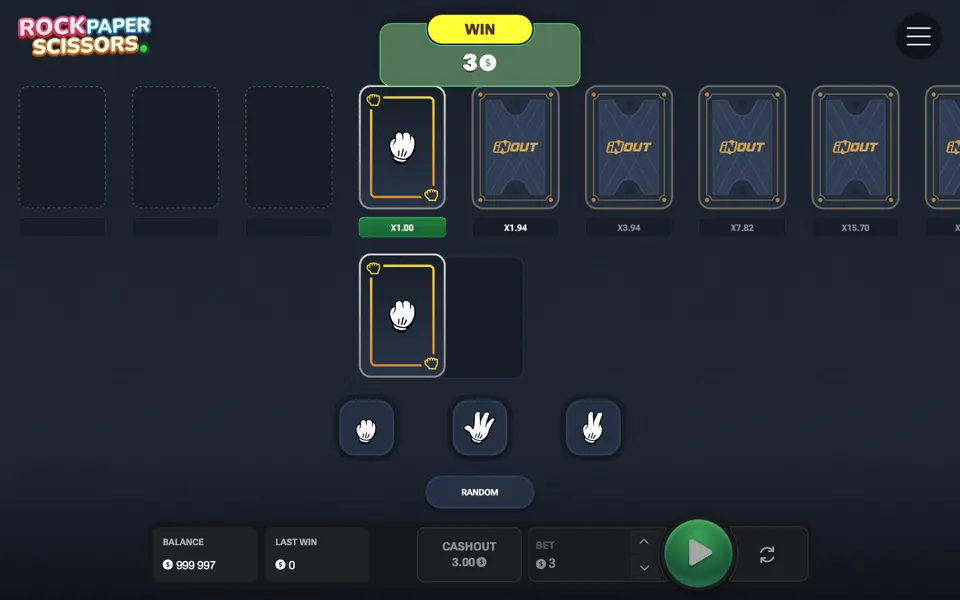
Draws, wins and the cashout button
The screenshot above is a draw on the opening hand: rock against rock. The ladder stayed on x1.00 and the Cashout button was greyed out, so a draw at the start doesn’t let you walk away with your stake. On the next hand paper beat rock, the ladder moved to x1.94 and Cashout lit up with 5.82 on a 3 USD bet.
So the button opens after your first win. From then on, every draw is free and every loss costs everything you’ve built in that round. Everything else on the screen is decoration around that trade.
Random, Autoplay and the stop settings
Random picks a hand for you. It doesn’t change your odds, because the opponent’s hand isn’t reacting to yours.
Autoplay repeats rounds on its own. Its settings include two stops: “stop if cash decreases by” a set amount, and “stop if the coef exceeds” a set multiplier. On a phone, the Play button reads “Hold to autoplay”. If you use Autoplay at all, fill in the loss stop first.
Checking a round: provably fair
InOut’s menu has a “Provably fair settings” panel. It shows your next client seed, which you can change, plus the SHA-256 fingerprint of the upcoming server seed, so the server is locked to its seed before you play. The panel states that the result is built from the server seed combined with “the first 3 bets of the round”, and that any bet can be checked from the bet history. In practice: change the client seed now and then, and spot-check a round or two.
Play the rock paper scissors demo first
On InOut’s game page, the Demo Play button loads the full game with a play-money balance. Nothing to download, no account. Twenty rounds there will teach you more about the ladder than any rules page, this one included. After that, our strategy notes put numbers on what you saw.