
Rock paper scissors strategy only works against someone with habits. People repeat what just won and switch away from what just lost, and a 2014 lab study measured exactly that. A casino round is different: InOut’s opponent hand comes from provably fair seeds, so nothing you see predicts the next throw. There, the only decisions that change your money are how much you stake and which rung you cash out on.
Rock paper scissors strategy against a person
Researchers at Zhejiang University recruited 360 students, sorted them into groups of six and had each group play 300 rounds, paying everyone according to how many rounds they won. The paper, Wang, Xu and Zhou, “Social cycling and conditional responses in the Rock-Paper-Scissors game”, ran in Scientific Reports in 2014 (full text). Two habits stood out.
- A player who had just won was considerably more likely to repeat the same hand than to change.
- A player who had just lost tended to switch to the hand that would have beaten the opponent’s winning throw. Lose with rock to paper, and scissors comes next.
Turn that into a rule of thumb. If your opponent just won, throw whatever beats their last hand. If they just lost, throw the hand they lost with, because their likely switch loses to it. These are tendencies, not laws. Someone who knows the trick can flip it, and a player who truly randomises can’t be read at all.
How to win rock paper scissors every time? You can’t
Against a random thrower, each of your three hands wins a third of the time, ties a third and loses a third, whatever you pick. That’s the mathematical point of the game, and the reason it’s used to settle arguments. “Every time” methods online are either psychology tips like the ones above, which give an edge over some people some of the time, or fiction.
Why none of it works on the casino version
The tricks above feed on a human opponent’s memory of the last round. InOut’s game has no such memory. Its fairness panel shows the SHA-256 fingerprint of the upcoming server seed, which locks the server in before you play, plus a client seed you can change. Any round can be verified afterwards from the bet history.
So there is no pattern to read, and nothing to sell. Predictor apps, “AI signals”, Telegram groups and Random-button hacks all promise to know the next hand. They can’t. The best they do is take a subscription fee. The worst ask you to install an APK or hand over a casino login.
What you control: the cash-out point
A draw replays the hand, so each step up the ladder is a straight 50/50 between winning and losing, provided a win and a loss are equally likely on each throw (they are if the opponent’s hand is uniformly random). That makes the chance of reaching rung n exactly 1 in 2ⁿ. Multiply by the multiplier and you get the average return of a player who always stops at that rung.
| Stop at | Multiplier | Chance to get there | Average return |
|---|---|---|---|
| Rung 1 | x1.94 | 1 in 2 | 97.0% |
| Rung 2 | x3.94 | 1 in 4 | 98.5% |
| Rung 3 | x7.82 | 1 in 8 | 97.75% |
| Rung 4 | x15.70 | 1 in 16 | 98.1% |
| Rung 7 | x125.42 | 1 in 128 | 98.0% |
| Rung 10 | x1,003.54 | 1 in 1,024 | 98.0% |
Rungs 1 to 4 are from the demo screen; rungs 7 and 10 follow the same pattern (0.98 × 2ⁿ, give or take 0.02). The quirk sits at the bottom. Banking every first win returns a point less than the studio’s 98% because InOut rounds rung 1 down to x1.94. Rung 2 is rounded up, so it returns a little more. Stake’s version pays a flat 0.98 × 2ⁿ, which is 98% wherever you stop.
None of this beats the house. It just means the one-win habit costs more than it looks.
Stake size and the cap
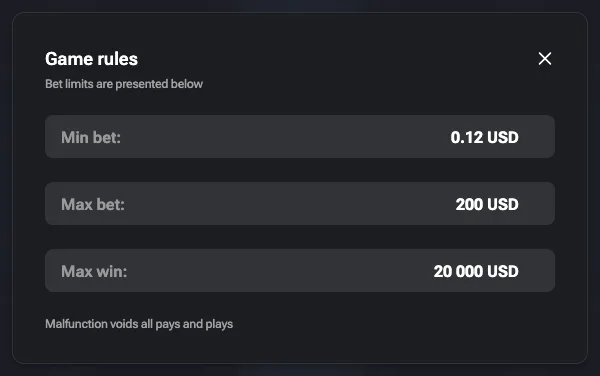
Higher rungs pay more on paper, but the casino’s max win trims them. In the studio’s demo the cap is 20,000 USD. A 200 USD stake hits it on the seventh win: rung 7 would be 25,084 USD, so the payout stops at 20,000, and no rung above it pays more. If you want long runs, a small stake keeps the cap out of the way; if you want the cap, you’re chasing a 1-in-128 shot at best.
Doubling up and other systems
The martingale (double after every loss, reset after a win) breaks here faster than at roulette. A first win pays x1.94, not x2, so from a 0.12 USD start a win after five straight losses still leaves you about 0.11 USD down. Lose eleven in a row and the next stake, 245.76 USD, is over the demo’s 200 USD maximum. You’d have lost 245.64 USD trying to make about 11 cents.
Flat stakes, a loss limit set before you start (Autoplay has a “stop if cash decreases by” field), and a fixed cash-out rung won’t beat a 2% edge either. They just make the session cost what you decided it would.